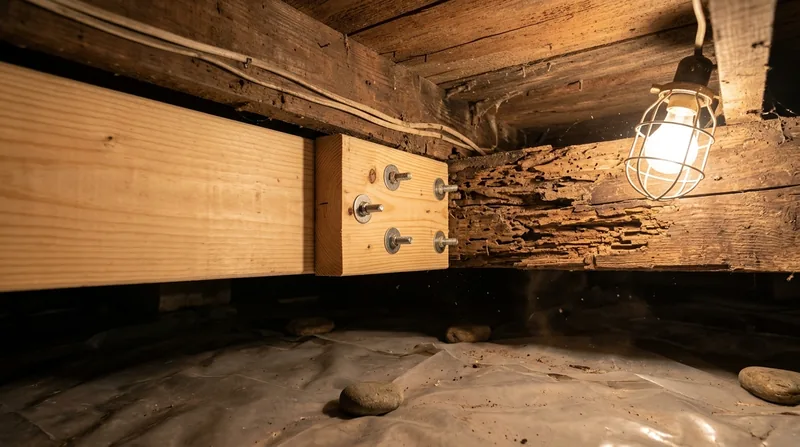




When a floor in an older Newport News home starts to sag or bounce, the cause is usually under the house. Joists weakened by termites or rot over a damp crawl space are the common culprits. The Peninsula's hot humid summers, heavy thunderstorms, nor'easters, and salt-laden air create ideal conditions for wood decay in homes ranging from the 1890s Colonial Revivals of the historic North End to the 1940s brick ranches of Hidenwood and the newer colonials toward Williamsburg. Floor joist and subfloor repair is not cosmetic work, it is structural: when the framing under your floor fails, the entire first story loses support. We sister or replace the failing joists, rebuild soft subfloor sections, and bring the floor back to level before the finish goes down. If you notice soft spots, a spongy feel underfoot, or visible sagging in a room, the framing is already compromised. Call us at (757) 392-0070 for a free estimate, or visit our wood rot repair page to understand the full scope of what we handle.
Why Floor Joist and Subfloor Failure Happens in Newport News Homes
The James River Peninsula sits between two major water bodies and experiences tidal influence, high humidity, and regular storm pressure from the Chesapeake Bay. Older homes with crawl spaces, particularly those built before 1970, often have poor drainage and ventilation underneath. Eastern subterranean termites thrive in this damp environment and work their way through sill plates and rim joists. Rot from standing water, condensation, and storm-driven rain weakens the wood fibers until joists can no longer carry the load of the floor above. The failure is gradual, which is why a soft or bouncy floor is always a warning sign, not an emergency, but it demands attention before the damage spreads.
- Eastern subterranean termites consume wood in crawl spaces and sills, leaving joists hollow and unable to support weight.
- Moisture from poor drainage, high humidity, and condensation causes dry rot and soft rot in the grain of Douglas fir and loblolly pine framing.
- Leaks from above or flooding from nor'easters and storm surge in low-lying neighborhoods can saturate subfloor sections and rim joists.
- Inadequate ventilation in crawl spaces traps humidity and accelerates decay in wood that should stay dry.
- Age and settlement over decades can create gaps where water collects and wood begins to fail.
Addressing these issues early prevents larger structural failures and keeps repair costs down.
Key info: In historic neighborhoods like Huntington Heights and Hilton Village, homes built in the 1910s and 1920s often have hand-hewn sill plates and rim joists that are particularly vulnerable to termite and moisture damage. A professional inspection of the crawl space is the first step to understanding what lies beneath your floor.
How We Repair Sagging and Soft Floors in Newport News
Our process starts with a crawl-space inspection to identify which joists are damaged, how far the decay has spread, and whether the subfloor can be saved or must be replaced. We assess the load path, check for active termite or moisture issues, and measure the sag to determine how much the floor needs to be lifted back to level. In most cases, we can sister new lumber alongside the damaged joist, which reinforces the framing without removing the original wood. Where rot is too extensive, we remove the failed section and install new joists, carefully supporting the floor above during the work.
- We access the crawl space and document the condition of each joist, rim joist, sill plate, and subfloor with photographs and measurements.
- We identify the cause of the failure: termite damage, dry rot, wet rot, moisture intrusion, or a combination of these.
- We shore up the floor using temporary support posts and beams to hold the load safely while we work.
- We either sister a new joist alongside the damaged one or remove and replace the failed section entirely.
- We rebuild soft or rotted subfloor sections, fastening new plywood or boards to the repaired joists.
- We use a laser level to bring the floor back to level or to match the existing slope if the home has settled over time.
- We document the work and remove all temporary supports once the new framing has fully settled.
The entire repair is done from below, so your finished flooring, carpet, or tile stays in place. For more on our structural carpentry approach, see our framing and structural carpentry page.
Example from the field: A 1950s ranch in Riverside had a soft master bedroom floor. Inspection revealed that the rim joist along the exterior wall had rotted from standing water against the foundation. We sistered a new rim joist using pressure-treated lumber, rebuilt 40 square feet of subfloor, and the floor came back to level. The work took three days, and the homeowner never had to move furniture.
Repair Methods and When to Use Each
| Approach | Description | Best for |
|---|---|---|
| Sistering | New joist bolted alongside the damaged one, sharing the load and reinforcing the assembly. | Moderate decay where the joist still has structural capacity and can be splinted rather than replaced. |
| Full Joist Replacement | The damaged joist is cut out in sections, removed, and a new joist installed in its place, toe-nailed and bolted to the rim. | Severe rot, termite damage, or structural failure where sistering would not restore adequate capacity. |
| Subfloor Patching | Soft or rotted subfloor sections are cut out and replaced with new plywood, fastened to sound joists below. | Localized rot or water damage in the subfloor where the joists themselves are still sound. |
| Rim Joist and Sill Plate Repair | The perimeter framing is reinforced or replaced to stop water infiltration and termite entry at the foundation line. | Moisture intrusion at the crawl-space wall, termite damage at the sill, or deterioration of the rim joist. |
| Floor Leveling | After structural repair, the floor is shimmed and adjusted to be level or to match the original slope of the home. | All joist repairs, to restore a stable walking surface and prevent doors from sticking or swinging open. |
Floor Joist and Subfloor Repair Cost in Newport News: What to Expect
A basic joist repair, including sistering one or two joists and patching subfloor, typically starts at $1,800 to $2,500 depending on the length of the joist, accessibility of the crawl space, and the extent of decay. Full joist replacement or multiple joists can run $3,500 to $6,500 or more. The cost depends on how many linear feet of joist need work, whether the rim joist or sill plate is also damaged, how much subfloor must be rebuilt, and how far the floor has sagged. A crawl space with poor access, standing water, or multiple failing joists will take longer and cost more. We provide a free estimate after inspecting the damage on site. For a detailed pricing breakdown across all our services, visit our full pricing page.
Getting 2 or 3 estimates from local carpenters is always smart. Compare what each contractor proposes to repair versus replace, and ask whether they will sister or fully replace joists. Some contractors default to replacement when sistering would be adequate and cheaper. Our approach is to repair whenever the wood justifies it.
Floor Joist and Subfloor Repair Near Me: What Newport News Homeowners Should Know Before Hiring
When you call a carpentry contractor for a floor repair, ask whether they are fully insured and whether they will pull a permit if the work is structural. In Newport News, alterations to load-bearing framing or changes to floor height may require a permit from the local building department, and requirements vary by the scope and location of the work. The contractor should defer to your local building department to determine what permits apply. Ask for references from recent jobs, and request photographs of the work before and after. If your home is in a historic district like the North End or Hilton Village, or if you live in a homeowners association community, check whether there are any restrictions on how the work can be done or what materials must be used. A good contractor will be familiar with these local requirements and factor them into the estimate.
- Verify that the contractor is fully insured and ask to see a certificate of insurance covering liability and workers compensation.
- Request at least two references from homeowners in Newport News or surrounding areas where the contractor has repaired joists in the past two years.
- Ask whether the contractor will pull a permit for structural work and who bears the cost if a permit is required.
- Understand the repair plan before work starts: will joists be sistered or replaced, and how will the floor be leveled.
- Confirm the timeline and whether the work will be done in phases to minimize disruption to your home.
For a free estimate and to discuss your floor repair with a carpenter who knows the Peninsula's homes and soil conditions, call us at (757) 392-0070 or visit our contact page to request a free estimate.
Floor Joist & Subfloor Repair in Newport News: Pricing Guide
| Service | Price | Details |
|---|---|---|
| Single Joist Repair (Sistering) | Starting at $1,800 | One joist reinforced with a sister beam, includes subfloor patching and floor leveling adjustment. |
| Multiple Joist Repair or Full Replacement | Starting at $3,500 | Two or more joists replaced or sistered, rim joist reinforcement, subfloor reconstruction, and leveling. |
| Rim Joist and Sill Plate Repair | Starting at $2,200 | Perimeter framing reinforced or replaced to stop water infiltration and termite entry at foundation line. |
| Complex or Large-Scale Job | On estimate | Multiple joists, extensive subfloor damage, poor crawl-space access, or active moisture issues require on-site inspection. |
| Travel | Included | No separate call-out fee or mileage charge within Newport News and surrounding service areas. |
| Free Estimate | Free | Response within 24 hours at (757) 392-0070, includes crawl-space inspection and written repair proposal. |
Indicative pricing, the exact cost depends on square footage, finish, and site access. Free personalized estimate within 24h at (757) 392-0070.


