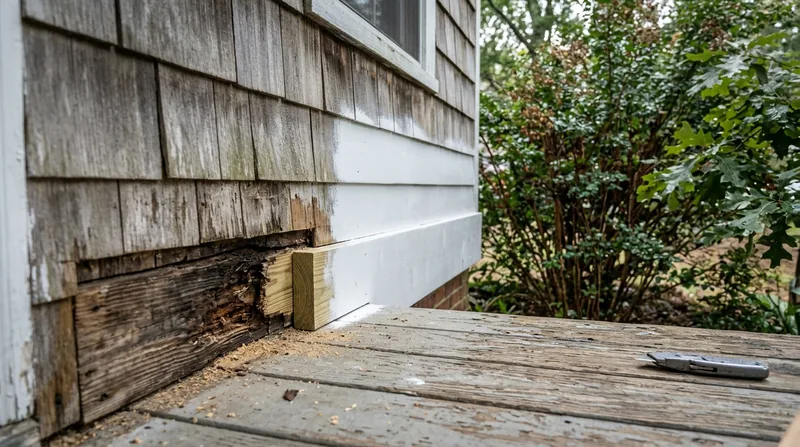




On the Virginia Peninsula, salt air, muggy summers and wind-driven rain off the James River create ideal conditions for wood rot to take hold in your home's sills, porch framing and exterior trim. Newport News homeowners face a particular challenge: the oldest neighborhoods like the historic North End and Hilton Village, built in the early 1900s for shipyard workers, sit on damp ground where crawl spaces stay wet for months. Newer colonials and split-levels across Denbigh, Kiln Creek and toward York County fare better, but porches, decks and fascia still absorb moisture year-round. Wood rot and dry rot repair stops the damage before it spreads into structural framing, and we cut out the decay, treat the sound wood and rebuild with rot-resistant lumber, not filler or cosmetic coatings. This is a lasting repair that protects your investment and keeps your home's frame solid.
Why Wood Rot Matters in Newport News: Climate, Moisture and Decay
The James River and Chesapeake Bay moderate Newport News winters and drive humidity year-round. Nor'easters and summer thunderstorms push rain horizontally into siding, soffits and porch ceilings. Sill plates and rim joists, especially in homes built before 1960, were often set too close to grade and sit above wet crawl spaces where air circulation is poor. Salt air accelerates wood degradation, and wood that stays damp for weeks at a time begins to soften and lose structural integrity. Left unrepaired, rot spreads into floor joists, subfloor and even the framing that carries your walls and roof.
- Sill plates and rim joists decay first, especially where they meet foundation or crawl-space walls.
- Porch framing, deck ledgers and exterior trim absorb wind-driven rain and stay damp for extended periods.
- Fascia, soffit and the lowest siding courses fail quickly in salt-air environments along the Peninsula.
- Crawl-space humidity and poor ventilation accelerate decay in floor joists and subfloor sheathing.
- Eastern subterranean termites often work alongside rot, compounding damage to structural wood.
Addressing rot early stops the spread and keeps repair costs manageable; waiting allows decay to penetrate deeper into the frame.
Key info: In Huntington Heights, a 1920s Colonial with a wet crawl space developed rot in the rim joist and three floor joists within two years of water intrusion. Early detection and repair cost $2,400; had the homeowner waited, the entire subfloor would have needed replacement at $8,500 or more. For a free assessment of sills, joists or porch framing in your Newport News home, call (757) 392-0070.
For more information on how moisture and termite activity interact with wood rot, see our Termite Damage Repair service page.
How We Repair Wood Rot: Assessment, Removal and Rebuild
We start by identifying the extent of decay using a moisture meter, a sharp awl and visual inspection. Soft, spongy wood that yields to pressure has lost structural capacity and must be removed. Sound wood at the perimeter of the rot zone is treated with a wood hardener to stabilize the remaining grain. We then cut out all decayed material, clean and dry the cavity, and rebuild the damaged section with pressure-treated lumber, redwood or Douglas fir, depending on the location and exposure. Sistering (bolting new framing alongside existing members) reinforces joists and beams without full replacement. The repair is fastened solidly, sealed against moisture and left to cure before any cosmetic finish is applied.
- We probe the damaged area with an awl to determine how deep the rot extends into the wood.
- All soft, degraded wood is removed with chisels and saws, and the cavity is cleaned and dried thoroughly.
- Sound wood at the repair boundary is sealed with wood hardener to prevent future decay.
- New lumber is cut to match the original profile and fastened with structural fasteners or bolts.
- The repair is sealed with a water-resistant finish appropriate to the location (interior, exterior, below grade).
This approach preserves the original structure and avoids the cost and disruption of full member replacement whenever the remaining wood justifies repair.
Local example: A 1940s brick ranch in Hidenwood had rot in the porch ledger board where water had pooled for years. We removed the decayed section, sistered a new pressure-treated board to the existing beam, and sealed the joint with exterior caulk. Cost was $1,200 and the porch is now solid. Full ledger replacement would have cost $2,800 and required temporary support and re-hanging of the entire porch structure. See our Deck & Porch Repair page for more on exterior carpentry.
| Repair Approach | Description | Best For |
|---|---|---|
| Localized cut-out and splice | Remove decayed section, treat sound wood, install new splice member fastened to existing frame | Rot confined to one area of a beam, joist, sill or trim; sound wood remains on both sides |
| Sistering | Bolt or lag a new member alongside the damaged member to share the load and restore stiffness | Joists or beams with moderate decay where removing the member would disrupt the structure |
| Full member replacement | Remove entire beam, joist or rim board and install new pressure-treated or rot-resistant lumber | Extensive decay throughout the member, or structural load calculations require full-size replacement |
| Exterior trim and fascia repair | Remove rotted fascia, soffit or siding course, install pressure-treated or cedar replacement, seal and paint | Exposed trim and siding on porches, decks and the exterior envelope where rot is cosmetic or shallow |
Wood Rot and Dry Rot Repair Cost in Newport News: What to Expect
Repair costs depend on the size of the damaged area, access to the wood, the species of wood being replaced and whether the repair requires temporary support or permits. A small localized rot repair in exterior trim or a sill plate typically starts at $650 and covers removal of decay, treatment of sound wood and installation of a splice or small replacement section. Larger jobs, such as sistering a floor joist or replacing a porch ledger, run $1,200 to $3,500. Full beam or rim joist replacement, or repairs that require temporary shoring or a structural engineer's approval, are quoted on estimate after an on-site inspection. Most homeowners benefit from getting two or three estimates to compare scope, materials and timeline.
Factors that affect the final cost include the depth and length of the decay, whether the wood is load-bearing or decorative, the accessibility of the damaged member, and whether the repair requires a permit (which is common for structural work and load-bearing alterations). We can help document the damage for your homeowners insurance claim if the rot resulted from a sudden event like a storm or roof leak. Visit our pricing page for a detailed breakdown of services and typical ranges.
Wood Rot and Dry Rot Repair Near Me: What Newport News Homeowners Should Know When Hiring
When you call a carpentry contractor to inspect rot, ask whether they carry insurance and can provide a certificate of coverage. Get a written estimate that describes the scope of work, the materials to be used, and the labor and timeline. Check references from past jobs in your neighborhood or similar homes. For structural repairs, clarify whether a permit is required and who is responsible for obtaining it; your local building department in Newport News can advise on thresholds and requirements. If your home is in a historic district like Hilton Village or the North End, confirm that the repair meets any HOA or historic preservation guidelines before work begins.
- Verify that your contractor carries liability insurance and is fully insured before signing a contract.
- Request a detailed written estimate that identifies the damaged members, the repair method and the cost of materials and labor.
- Ask for references from homeowners in Newport News or nearby areas where the contractor has repaired similar wood rot.
- Check with your local building department to determine whether the repair requires a permit or an engineer's review.
- Confirm any HOA or historic preservation restrictions if your home is in a protected neighborhood.
A reputable local contractor will answer your questions clearly, stand behind the work with a warranty and help you navigate permits and insurance claims. Contact Newport News Carpentry for a free, no-obligation estimate on wood rot repair in your home.
Wood Rot & Dry Rot Repair in Newport News: Pricing Guide
| Service | Price | Details |
|---|---|---|
| Small localized rot repair | Starting at $650 | Removal of decay, treatment of sound wood, and splice installation in trim or sill; cost increases with depth and length of damage |
| Joist or beam sistering | $1,200 to $3,500 | Bolting new lumber alongside damaged member; cost depends on joist span, load-bearing status, and access to crawl space or underside |
| Full member replacement | On estimate | Removing and replacing an entire joist, beam, sill plate or rim board requires site inspection to confirm size, load and whether shoring is needed |
| Porch ledger or fascia repair | $800 to $2,200 | Removal of rotted ledger or fascia, installation of pressure-treated or cedar replacement, sealing and finish paint or stain |
| Travel and estimate | Free | No charge for estimate in Newport News and surrounding service areas; response within 24 hours at (757) 392-0070 |
Indicative pricing, the exact cost depends on square footage, finish, and site access. Free personalized estimate within 24h at (757) 392-0070.


